

from CAW by Dani Burlison
"Poison the powerful. Bind them and their oppressive deeds"
You may have heard of her: Aradia, daughter of Diana, the Roman moon goddess, and Lucifer, the personification of the morning star. Siblings in this particular tale, they create and birth Aradia with the sole purpose of sending her to earth to help liberate Italian peasants from the crushing weight of the ruling class. The lore says she was meant to teach witchcraft and sorcery to the disempowered resistance, so they could utilize the teachings to rise up and win the class war. To poison the powerful. To bind them and their oppressive deeds from causing further harm.
At least this is what Charles Godfrey Leland relayed in his slim, influential 1899 book, Aradia: Or The Gospel of the Witches.
“And thou shalt be the first witches known;
And thou shalt be the first of all i’ the world:
And thou shalt teach the art of poisoning;
Of poisoning those who are the great lords of all;
Yea, thou shalt make them die in their palaces;
And thou shalt bind the oppressor’s soul (with power)”
The book itself includes invocations, spells, tales of Aradia’s origins, and claims of a secret witch society who had a long, unbroken lineage of practicing folk magic and pre-Christian spiritual and healing traditions throughout Italy. In the book, followers of Aradia are instructed to gather in groups and have monthly naked meetings in forests during the full moon in honor of Diana until “…the last of your oppressors shall be dead.”
“If I were just to look at the book itself without the modern view, I would say Aradia is an initiator, she is someone who elevates people who are really not just disenfranchised, but slaves; enslaved in their souls, enslaved in their bodies,” says Dr. A.D. Manns, cultural historian and author of Aradia's Hidden Hand: The Untold Life of Roma Lister (Hexen Press, 2025). “And through her intervention, she's bringing these subjugated peoples to another level, allowing them to gain a certain degree of mastery.”
It is thrilling to consider; not a savior coming to rescue everyone, but rather a divine ally of sorts arriving with the power of organizing with the people and providing them with more tools to fight.
Poison those in power. Cast spells. Achieve collective freedom.
A woman named Maddalena (sometimes known as Margherita or Maddalena Talenti) was Leland’s paid informant who collected, and provided Leland with, information detailing Aradia’s origin story as the symbol of resistance and uprising she is portrayed as in Aradia. Maddalena herself claimed she was a link in the unbroken lineage Leland described in the book, a Tuscan and Etruscan witch, a role she said was passed down to her through generations.
Reception of the book has been complicated. It has been discussed, critiqued, praised, referenced, evaluated. It even influenced the modern witchcraft and neo-pagan revivals in the mid-1900s. Wicca has roots in Leland’s Aradia, too; Gerald Gardner was deeply inspired by the book and adopted much of what he read and wove it into spells and rituals for his Gardnerian Witchcraft teachings. Doreen Valiente’s Charge of the Goddess, which is an influential piece of Gardnerian Wicca’s Book of Shadows, was also heavily inspired by Aradia’s modern lore. And Stregheria, or Italian American witchcraft, which was popularized by Raven Grimassi’s work, can also follow its threads back to Aradia. Tales of everyday people being taught to fight back against oppression is a strong and enduring theme that has led these spiritual traditions to carry on, growing in popularity even more so in the rapidly tilting times we are in today.
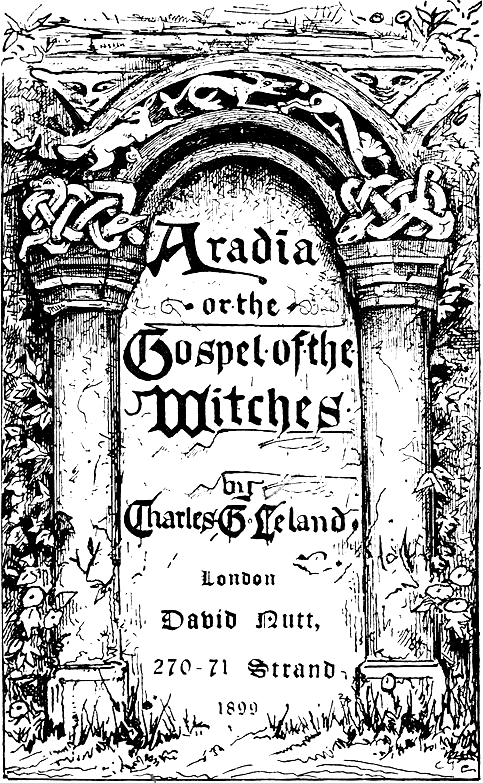 Aradia book cover (Wikicommons image)
Born in Pennsylvania in 1824, Charles Godfrey Leland was somewhat of an armchair anthropologist and self-taught journalist, with a law degree and an education dabbling in languages and poetry. He fought in the French Revolution of 1848 and had a keen interest in the arts, founding and directing the Public School of Industrial Art in Philadelphia in 1880, an institution that taught crafts to the disadvantaged children of the city.
Aside from his eclectic education and an interesting assortment of career paths, Leland is probably known best today as a Folklorist; he traveled extensively and took a special interest in the Roma of Europe, Native Americans, Irish Travelers, and other marginalized and oppressed people, writing books and magazine articles about them; some of Leland’s perspectives and writings are fairly problematic, with stereotyped perspectives on the cultures he studied, especially in regard to the Roma. It can be assumed that some of this seeped through in Aradia.
He attributed his varied interests in everything from the occult to the arts and law—and as a Union soldier who fought at the Battle of Gettysburg—to an incident he claimed happened while still a newborn. In her biography of Leland, his niece Elizabeth Robins Pennell writes that Leland often shared a story of his Dutch nurse performing a ritual on him in the family’s attic, which included candles, a bible, a key, a knife, salt and even some money to set him on his path to becoming “a scholar and a wizard.”
Again, because of his eclectic interests and experiences, it might have been difficult for Leland to be objective about his research, particularly in regards to Aradia and Italian witchcraft. How Leland acquired the information he used for Aradia: Or The Gospel of the Witches, was tricky, at best.
Dr. Sabina Magliocco is a professor emeritus of anthropology at UBC Vancouver and is a scholar of religion (including modern pagan religions) with expertise including folklore studies, witchcraft and magic. She’s conducted in depth research about the origins of Aradia’s lore and agrees that when it comes to Leland’s interests in marginalized people and their world view, he had a romantic perspective of the people and lore he wrote about.
“It's very likely that [Maddalena] Talenti knew this and that she shaped her legends and the material she gave him to suit what she thought that he would want to hear,” says Magliocco. “So where does that leave us? Certainly, in the book Aradia, there's a lot of stuff that is probably elaborated or invented. However, there's a good chance that a figure called Aradia existed in Italian folklore.”
One point that is important to consider in Maddalena’s information gathering and sharing, though, is the context of what was happening in Italy during the time she provided it to Leland.
The Italian peninsula was on shaky, tumultuous grounds in the 1800s.
Though a considerable win for the ruling class, the Risorgimento—the unification of Italy in 1861—was a failure for millions of laborers and other impoverished people, and did not deliver the promise of stability. Instead, it carved out a deepening divide between the poor and the ruling class. As Antonio Gramsci wrote in his Prison Notebooks, it was a “passive revolution that wasn’t a revolution at all.” It ignored the needs or input of the working people and pushed Italy toward a tipping point, exasperating the already dire circumstances for millions of people. Many argue that this failed revolution paved the way and opened the door for fascism to barge into the country decades later.
Instead, the Risorgimento brought with it the expansion of the wealthy class purchasing and privatizing large swaths of land, rapidly swallowing up communal agricultural spaces that many relied on to feed their families. A loss of roughly two million hectares (five million acres) of forest accompanied the vanishing of the beni comuni (common lands), with private landowners quickly clearcutting trees to plant crops. Peasant farmers became sharecroppers, with their labor exploited on now-private property, and the rapid deforestation contributed to erosion that, in turn, resulted in poor crops for at least two years in the early 1870s. Poor crop yields on leased land meant debt owed to landowners by peasant sharecroppers, sometimes for years. And to add to the misery, waves of disease swept through Italy over and over again.
Malaria created one health crisis in the mid 1800s, with 15-20 thousand people dying per year. Next came numerous cholera outbreaks, which killed roughly 113,000-15,000 people in the 1860s and another 50,000 in 1880.
The ruling class—including doctors and members of the clergy—believed that because the poor were the most impacted by the disease, they were responsible for spreading it. As such, they needed to extinguish all peasant revolts and sent the military to poor rural and urban communities to enforce order, sometimes violently. The troops brought cholera along with them. And the strict military actions of enforcing fumigation and other forms of intense disease-fighting tactics led to anger and more uprisings in poverty-stricken Italy. This oppression created further animosity and distrust toward the wealthy and religious classes.
The first major wave of cholera was also accompanied by a grain tax in 1868, by the Italian minister of finance, Quintino Sella, who was subsequently labeled "starver of the people."
The Grist Tax, which was catastrophic for the peasantry, was meant to remedy the severe deficit the country was facing because of excessive military spending, both in battling various entities in the fight for unification, and by oppressing peasant uprisings. Because the main food staple of the poor was bread—and they were already suffering from devastating epidemics—this struck another detrimental blow to the people, creating increased agitation to fuel the anger growing across the peninsula.
As many struggled to survive under these brutal circumstances, seeds of revolution also spread through the new nation. The movement of the Sovversivo (the subversives working to overthrow authority) spread from the peasants in the countryside to the poverty stricken in the cities and back again, winding its way down every alley and field of crops. The perseverance and inspiration of these revolutionaries is carried on in international class struggles today.
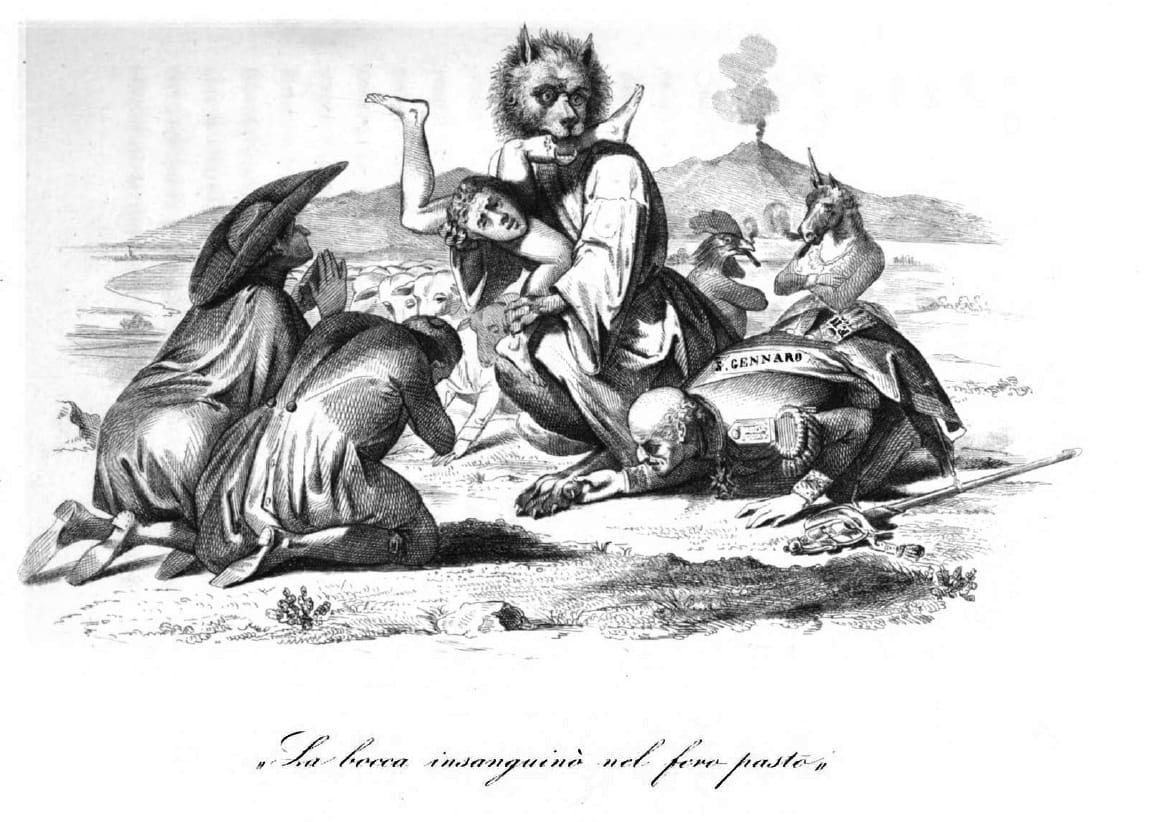 Depiction of Silcilian repression by Neapolitan government 1848 (Creative Commons)
In the south, braccianti (day laborers) began fighting back by keeping some of the harvested crops for their families and using other, more passive “weapons of the weak” to resist. Some destroyed land deeds and otherwise sabotaged landlords around the country.
In the north, whispers of resistance were heard from women working long, backbreaking hours in the rice fields. This is where many claim the first versions of Bella Ciao were sung as the women lamented their ruthless working conditions and rebelled—through song—against greedy landowners.
While the Risorgimento was still in early stages of development, Propaganda of the Deed was first outlined in 1857 by Italian Socialist Carlo Pisacane (shortly before leading a raid to free prisoners in Ponza, and his subsequent death in June of that year). The 1870s saw a surge in anarchist thought throughout Southern Europe, and in Italy in particular. The infamous revolutionary framework of Propaganda of the Deed, which advocates direct action against the ruling class establishment, became inspiration for anarchists fighting against the bourgeoisie during the years surrounding the Risorgimento; the framework was even endorsed at the 1881 International Anarchist Congress in London. The hope was that if the people could take bold revolutionary direct actions against the oppressor class, the rest of the exploited population would follow suit, leading to collective liberation. As Pisacane once famously said, "ideas spring from deeds and not the other way around; the people will not be free until they are educated, but they will be well educated once free."
While working in dire situations and dealing with extreme hunger, peasants continued to revolt. And although they were continuously met with violent oppression, they continued to rise up.
There is more, and I could go on, but life was brutal, and the ruling class continuously dealt blows against the masses, keeping their boots and bibles pressed down on the necks of the people. It was in the trenches of this social and political upheaval, a time when people were likely desperate for a figure like Aradia to offer some empowered hope and encouraged resistance, that the her story made its way into Charles Godfrey Leland’s hands.
“The people with power, they don't need magic. They have capital and they can exploit people with that capital,” says Magliocco. “The people who need magic are the people who don't have access to any means for making their vision of what they want to come true. The only thing they have is appealing to supernatural powers or trying to use those supernatural powers themselves to get something.”
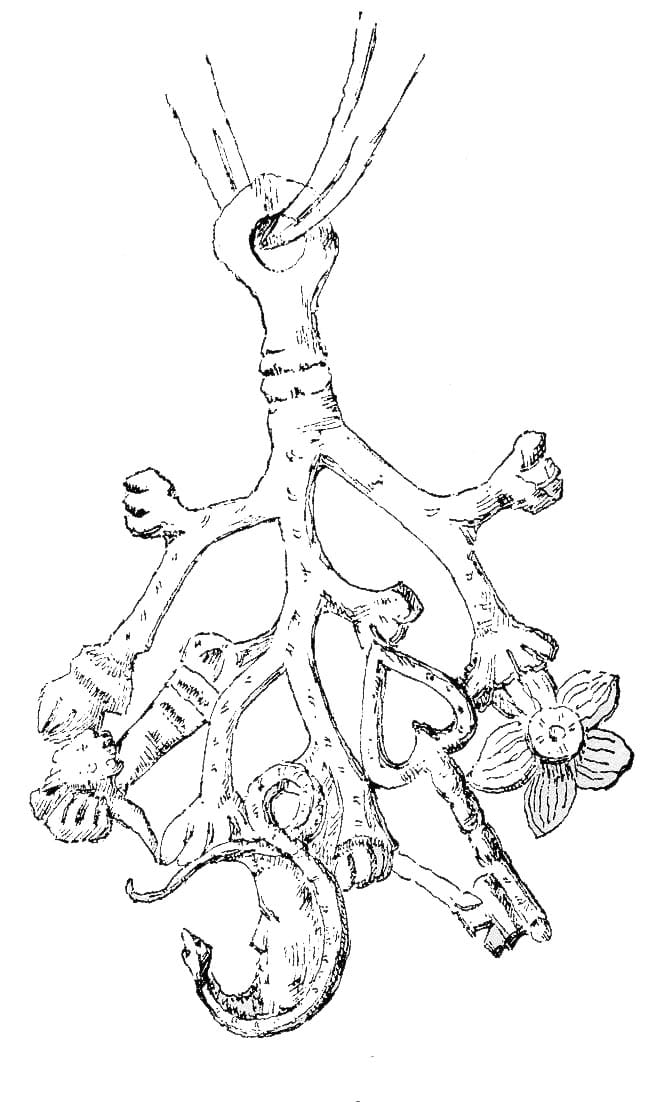 19th century drawing of a Cimaruta amulet used in Italy against the evil eye (Wikicommons)
Italy was once rich with folk magic (much of which carries on in one form of another today). The folk magic practitioners—the herbal healers, makers of modest protection charms and rituals for humans and livestock alike, detectors of the Malocchio, or evil eye—were mostly peasants and used their folk healing practices to improve conditions in everyday life.
The witch hunts in Italy during the 16th and 17th centuries—though not nearly as deadly as neighboring countries of Germany where up to 30,000 were killed over several centuries (Italy, by comparison saw between 400-2,500 deaths), led much of these folk practices to be extinguished or widely adapted and merged with the church through the use of Catholic saints after the earlier witch hunts in Italy.
The last witch hunts ended a century before the height of the fairly popular spiritualist movement, which, unlike Italian folk magic, centered seances, mediumship or communicating with the dead, spirit table-tipping and spirit photos, and mostly appealed to the more privileged middle and upper classes. The table-tippers in the Spiritualist movement lived comfortable lives and were safe in practicing this form of magic.
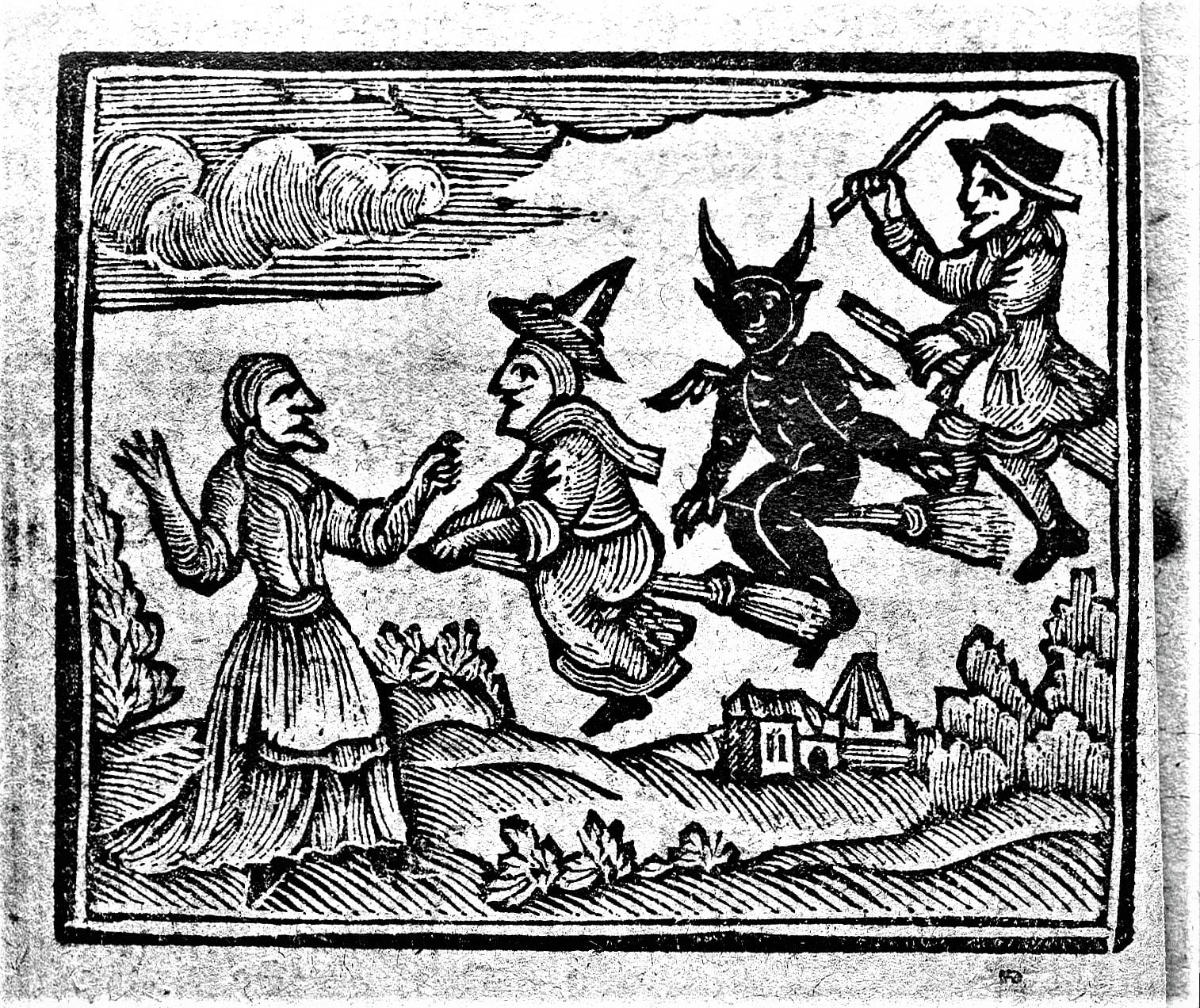 "The History of Witches and Wizards" (creative Commons)
Among the spiritualists in Italy, was an English-born woman named Roma Lister, who in some ways maneuvered the thin veil between the world of peasant folk magic and the showy world of entertainment Spiritualism. She may have also contributed to Aradia’s story alongside Maddalena.
Leland met Lister around 1892, and the two remained close friends until his death in 1903. He was drawn to her intellect and to her charismatic personality, and to her connection to the spiritualist and folklore community in Italy.
Manns says that a memoir written by Countess Walburga Paget, an English-German aristocrat in Florence who often hosted artists, politicians, and occultists at her home, recounts spending time with Lister in Florence. She recounted that Lister would bring her tarot cards and crystal balls and share stories of witchcraft. Manns also points out that Lister had experience summoning spirits and had a spiritualist and theosophical perspective on things, and wrote about witchcraft and Italian folklore in her own memoirs.
Beyond her prominence and experience in the spiritualist community, Roma Lister was a friend of—or at least well acquainted with—Maddalena.
“She definitely knew Maddalena. And according to Leland, Maddalena taught Roma Lister different magical things; not just card reading, but also, as he calls it, different forms of the black art,” says Manns. “And there’s a moment where Leland is with Maddalena, and Maddalena is doing a ceremony, and she's demonstrating a ritual, and he says that Roma Lister's there taking notes.”
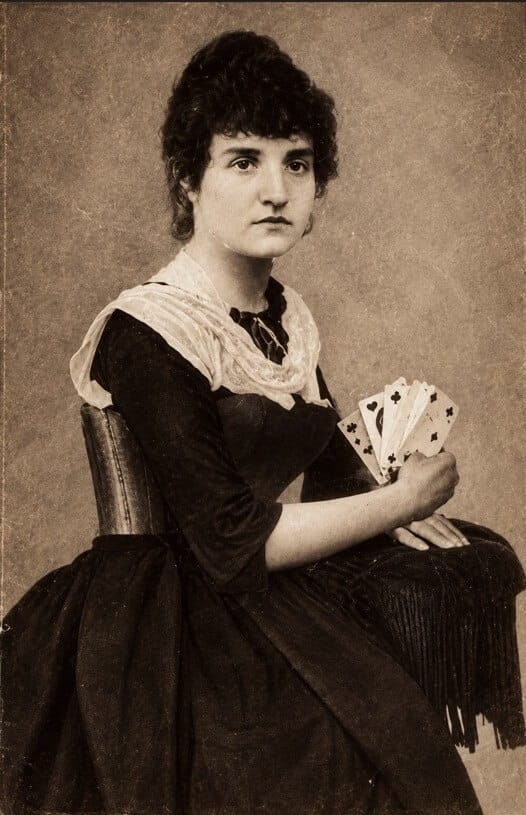 Maddalena of Florence (public domain image)
If we think outside of the box, it isn’t out of the question to assume that Lister had assisted Maddalena in formulating the Aradia information presented to Leland. It’s also worth considering–again, maybe further outside of the box– that Roma Lister may have drawn on her experience as a spiritualist and channeled Aradia’s story. Or in the very least, as suggested by Manns, that there was some magic at play during the creation of the book.
“Even if you remove the idea of evocation, the fact that maybe she summoned parts of it,” says Manns. “You could still say that there's an interesting relationship in the way in which material is being transferred to Leland, who's basically the editor; he is being influenced by the two of them and the things that they're doing and what they're describing.”
Again, Leland was fascinated by witchcraft and very likely had a vision of what it looked like, especially given the wildly imaginative ideas that people had of witches in the centuries leading up to Leland’s time in Italy. And Maddalena, Roma Lister, and perhaps others he had met at the time fit the profile, which he mentions vaguely, and in passing, in his introduction to Aradia, fed him what he longed for.
“If you imagine the philosophers, the alchemists of the Middle Ages, they had an idea of what the philosopher stone should look like,” says Manns. “And in a way it's like Leland has this idea of what witchcraft should look like, and then that's what ends up surfacing in Aradia.”
Still, there is evidence that a figure like Aradia existed at some point in Italian folklore. Maybe just not the exact version we leftist witches have adopted as our own.
“We're not really talking here about historical fact. We're talking about a sacred narrative. So it's a little bit like saying, ‘Is there any evidence that Zeus exists?’ Well, that's kind of not the point,” says Magliocco. “Aradia is a real figure, but this idea that she's the daughter of Diana and Lucifer and that she came to earth to teach political resistance to Italian peasants, this is pretty much developed by Leland or by Leland's interlocutor.”
Magliocco spent time collecting legends in Sardinia in the 1980s. During her research, she heard tales of a figure called s'Araja (s'Araja means the Araja, and Araja is a version of the Italian word Aradia). In Sardinian folklore, there are two versions of s’Araja.
“s'Araja justa generally rewards good behavior or gender appropriate behavior on the part of young women who had spun and woven enough for their dowry, “says Magliocco. “s'Araja dimoniu leads a raid of spirits of the dead that ride through the sky at night and they make a lot of noise and they can, in some cases, indicate who will die within the year.”
Magliocco says that at some point these figures were introduced into Sardinia, most likely during the period of Pisan and Genoese occupation in the 12th and 13th century. This, according to Magliocco, means that in Italy in the 12th and 13th century, there was a figure called Aradia. She points to versions of the name Aradia associated with central and northern Italian versions of La Befana, “the good Italian witch who visits children on the eve of the epiphany, and again, rewards good little children with sweets and candy and punishes naughty children by leaving them coal.”
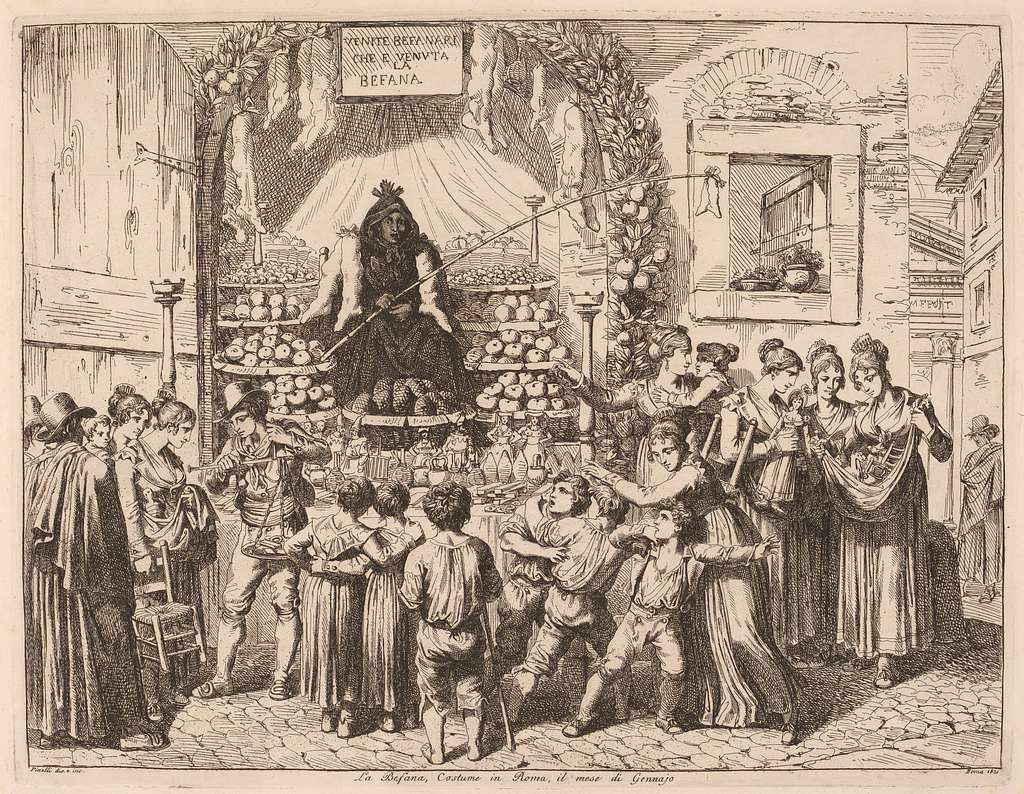 Illustration of La Befana (public domain image)
“This is part of a whole body of folklore about supernatural women who fly through the sky, who have some kind of sense of justice, and that existed in Italy, certainly from the high Middle Ages,” she says. “And sometimes they lead a raid of spirits of the dead.”
These legends match an early medieval legend about Herodias, a biblical figure and earlier version of the Aradia we know today: Herodias was the mother of Salome, who had demanded the head of John the Baptist, and whose punishment for his death was to dance through the air eternally without rest. Salome and Herodias eventually merge into one figure over time, possibly, as Magliocco says, because it was Roman custom for the women in one family to be known by the name of that particular family.
“Now we've got this wicked figure who is punished by wandering through the air and she begins to merge with other legends because this is what legendary material does” says Magliocco. “If you work with any contemporary legend material like aliens or Bigfoot or any of that stuff, these stories start to mush into one another.”
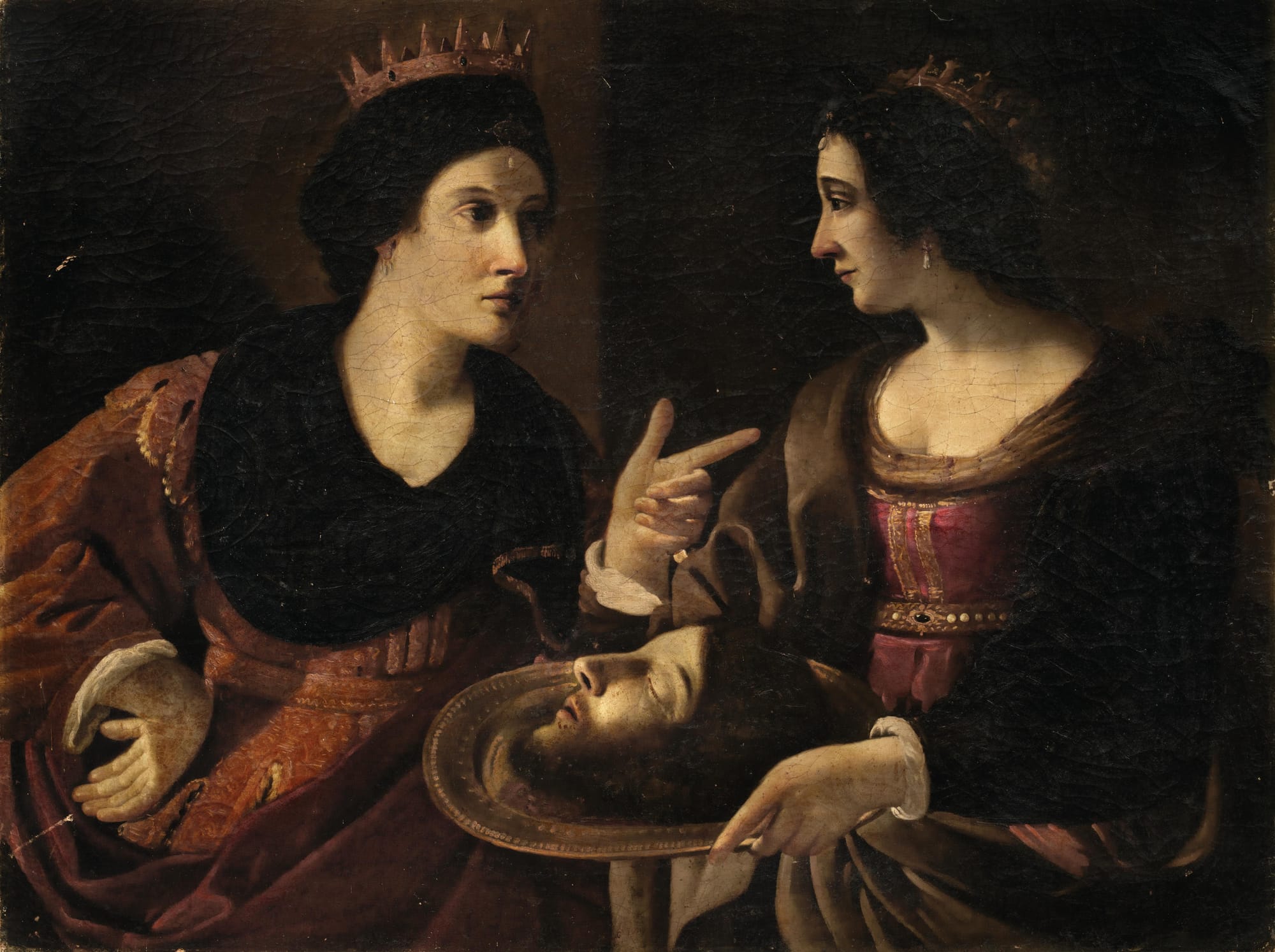 Herodias and Salome with the Head of John The Baptist (public domain image)
Aradia continues changing and growing today, and the hunger for her—or at least the archetype of her—seems to be spreading, as well. She validates the peasants’ recognition that the systems they were told were unchangeable and that insisted their oppressive circumstances were fated, were lies. Aradia offering the people the power to unshackle themselves from the harms of the ruling class was a gift.
Destroy the system in which the overlords wield absolute control. Bring them to their knees right in their own homes.
“If we go back to the art of poisoning, these secret acts to exert your power in even the darkest of situations, the fact that you can be literally a slave or in a horrible situation, and there's a sliver of hope, and then you are extricating yourself from that situation,” says Manns. “I think that's really compelling.”
We may never know for certain the exact origin of the modern telling of Aradia as an answer to peasant disempowerment. The written manuscript Leland claimed to receive from Maddalena, Il Vangelo delle Streghe, disappeared shortly before Aradia was published. And does it really matter? Do we need evidence of her legitimacy? Folktales can and do indeed morph and evolve over time to reflect social conditions, to integrate the narrative with the circumstance of the time. We don’t always settle with one political or world view, we don’t all stay with the same career throughout our lives. The needs of our communities are fluid, and we often have to step back, readjust, and reprioritize our roles to fit those needs. If we can change and grow and adapt to the changes in the world, can’t our deities do the same?
As my friend Phoenix LeFae points out in a piece she wrote for The New Aradia: A Witch’s Handbook to Magical Resistance anthology, “The more we call on Aradia, the stronger she gets—for what you feed with words and deeds grows. We cannot know the details of her origins, yet we can see what she has become and what she is becoming: a Goddess of witchcraft, power, and resistance.”
Words are indeed powerful. Deeds even moreso.
“We are once again in a period in which there are huge wealth disparities. And not unlike the peasants that Leland wrote about, we have a system in which wealth has been concentrated in the hands of very few billionaires,” says Magliocco. “Everyday people, even middle-class people who maybe grew up to expect a different kind of way of living, are struggling. Folks are struggling to pay for food, for housing. Aradia becomes a symbol of everything that leftist witches want to achieve. In other words, we want to achieve a more just world through magic.”
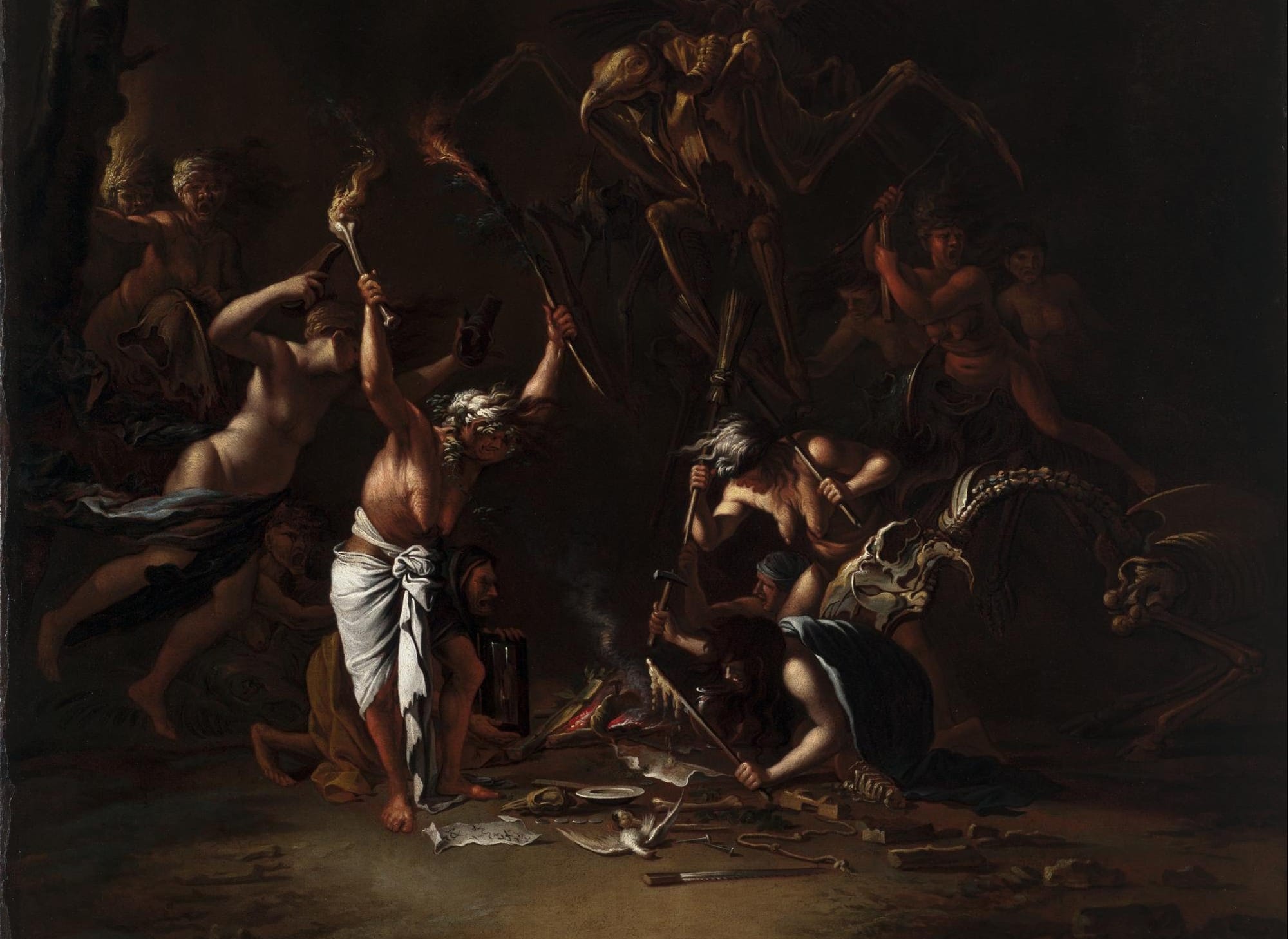 Salvator Rosa, "Witches Sabbath." (Wikicommons image)
What inspiration can we find from Aradia while fighting back against our modern ruling class, those who have shown us time and time again that they are certainly not—not now or ever—coming to save us? Who have, in fact, created the very conditions we live under today? We give them power with our votes, we give them power with our passivity.
Witches and others in the margins have provided care and protection outside of the system as long as societies have existed; midwives and healers and weavers and ritualists and community organizers and other sovversiva had (and still have) immense power. We can continue working or infiltrating in the shadows, poisoning the overlords (metaphorically?), creating class solidarity, sharing knowledge and skills and building a true resistance, remembering that all we have is each other and we need to start acting like it.
Manns points to resistance fighters against Nazis in France, the subversion of using underhanded subterfuge within corporations—whatever we do, the key is to organize ourselves outside of the religious and political tyranny.
“Aradia says: you can wield this sorcery. I'm giving you the knowledge, but you're not sitting there like you can't do anything by yourself and somebody's pulling you up into the heavens,” says Manns. “Aradia is the initiator, she is showing you these secrets, and then you take that and act accordingly.”
"Ye who are poor suffer with hunger keen,
And toil in wretchedness, and suffer too
Full oft imprisonment; yet with it all
Ye have a soul, and for your sufferings
Ye shall be happy in the other world,
But ill the fate of all who do ye wrong!"
Ill the fate of all who do ye wrong. So mote it be.
Comments
Interesting piece but…
Bugs Bunny (not verified) Tue, 11/03/2026 - 07:37
Interesting piece but Magliocco is wrong on the ruling class not possessing magic; Mircea Eliade makes a convincing argument that advertising is a form of dark magic systematised and Jason Mohaghegh goes further in that they reach for it in times of crisis either in response or advance of the masses’ use. While the Acephale were doing righteous rituals in woods, both American Nazis and German Nazis had competing dowsing units…
"The witch hunts in Italy…
ANARCHIST SOUR… (not verified) Thu, 11/05/2026 - 02:39
"The witch hunts in Italy during the 16th and 17th centuries—though not nearly as deadly as neighboring countries of Germany where up to 30,000 were killed over several centuries (Italy, by comparison saw between 400-2,500 deaths), led much of these folk practices to be extinguished or widely adapted and merged with the church through the use of Catholic saints after the earlier witch hunts in Italy."
There is still literally no evidence of this. This is the same sort of BS that white neopagans have been peddling to assuage their white guilt since day 1: "yeah, we're actually indigenous too, we got genocided and christianized too :(" even when the evidence shows otherwise. Any 'magic' practices in Italy extant in the 16th and 17th centuries would have already been 'adapted and merged' with the Catholic church. Folk magic appears out of the blue, no lineage needed, because people don't need anything to invent random bullshit.
I actually know this for a fact, because I've transcribed and translated a number of magical and divinatory manuscripts from late medieval and early modern Italy. Let me tell you what lower class people used magic for in the 16th century: predicting lottery numbers. That's literally one of their only concerns. Even the non-literate peasants were trying their hand at this, too, and they would use guides that had nothing but pictures and numbers for translating dreams to winning picks.
And instead of trying to make it Christian, they tried to make it Jewish and called anything and everything 'cabala'.
I'm no Marxist, but folk magic used by the dominant culture and ethnicity is going to be, at most, an opium of the masses. They were using magical techniques to try and alleviate their suffering. They weren't trying to curse their masters or feudal lords. I wish they were, but they weren't.
” This is the same sort of…
Bugs Bunny (not verified) Thu, 11/05/2026 - 07:50
In reply to "The witch hunts in Italy… by ANARCHIST SOUR… (not verified)
” This is the same sort of BS that white neopagans have been peddling to assuage their white guilt since day 1: "yeah, we're actually indigenous too, we got genocided and christianized too :(" even when the evidence shows otherwise”
Matey, you’re WASPian, you are an intruder in someone else’s country. We don’t share your white guilt in Europe because we’re literally from here. It’s like being lectured by an Afrikaans, the absolute fucking cheek.
See that costly university education was worth it cause a cursory look at one country says the Romans turned up, killed the Druids, desecrated their sites, destroyed their records, installed their own gods and later Christianity. The other Celtic regions got the same, bar Ireland where the Vatican sent their rats. Now let’s talk about the etymology of Los Angeles.
Well, seems like you did…
anonymous (not verified) Thu, 11/05/2026 - 20:51
In reply to ” This is the same sort of… by Bugs Bunny (not verified)
Well, seems like you did took far too *cursory* looks at "your" history, as the Vatican dates back from the Mussolini regime and Catholicism is much older in Ireland.... but also the UK before some douche king had decided to create his own church coz everyone knows the story.
"intruder in someone else's country"... for fuck's sake. Why is such racist, xenophobic tool being allowed to comment here? It's called "immigration", you dirt bag.
I'm not a WASP, I'm actually…
ANARCHIST SOUR… (not verified) Fri, 11/06/2026 - 03:52
In reply to ” This is the same sort of… by Bugs Bunny (not verified)
I'm not a WASP, I'm actually a so-called Native American from one of the Rio Grande pueblos straddling the fake border of US and Mexico. You know, someone whose ethnic religion actually was forcibly surpressed by Christianity. The people who came here and did that looked like you, talked like you, had the same culture as you, and sent the resources and money they took from us back to you. It doesn't matter if you're European or American bud.
Anyway, Romans did not 'turn up and kill the Druids', at least not in the sense you're talking about. They especially did not do so in Scotland or Ireland, which they never reached. Nor did they 'install their own gods' over Celtic ones, instead they immediately absorbed Celtic religious rituals and actually preserved them for posterity. That is why there are countless votive plaques and epigraphic monuments in Latin to Celtic deities like Inciona (known from finds in Luxembourg), Ricagambeda (fort at Blatobulgium), Moccus (known from Langres), and so on. If the Romans were really trying to surpress Celtic religion, they did a really bad job at it, and if they were really trying to destroy their records, they did an even worse job at it by helping the Celts make inscriptions in Latin. The Romans were not in the business of forcing people to convert or even to leave their cultures. Part of the reason they were able to defeat other empires was that they usually left their conquered territories to their own devices if they provided the economic resources and infrastructure needed for empire-building, which is much preferable for conquered peoples compared to what (e.g.) the Carthaginians were doing. Gaul and Britain are perfect examples of this; the immediate absorbtion of Germanic tribesman in late antiquity is another good example, and arguably what led to the 'fall' of the Western empire and the rise of the various barbarian kingdoms (Ostrogoths, Visigoths, Vandals, etc.)
This is just another way that white people assauge white guilt, and your reply proves it. You tried to deflect it by claiming I was a white settler then spread some more pseudohistory about how you were genocided too :((( because your ancestors (or some of your ancestors, rather) decided to convert to Christianity to build or sustain economic ties with Christian polities in the Mediterranean. It's just BS identity politics for white people.
I'd like to complicate this a little.
anonymous (not verified) Fri, 11/06/2026 - 17:16
In reply to I'm not a WASP, I'm actually… by ANARCHIST SOUR… (not verified)
Yes, Rome was often comfortable with other religions being practiced in its empire, but that does change. Much like the European rulers to come later, Roman Emperors convert to Chrisianity, but their people may or may not be forced to convert, depending on the specific ruler. But I also see in the mentioning of Druidry, I see Medelane Murrey's influence in the story being told about Rome and the Celts. I'm also the one who points out in conversations with baby witches that that the witch hunts were killing Christians, not practitioners of witchcraft. Because torture makes you lie just to get your inquisitioner to stop, no matter what damn stupid things he wants you to admit to from his own messed up understanding of the world. I'm not saying there's a comparison to be made, pain for pain. Even before those murderers and enslavers decided to skip going around Africa into the Indian Ocean and Pacific, they were enslaving and genociding in those same areas by going around the long way. This was the time when a bunch of rich merchants could send fleets of ships to conquer, enslave and extract resources instead of needing a royal person to finance such journeys. In other words, all these discoverers of places were showing up with premeditated plans to enslave or kill everyone who didn't work for their company. The Dutch are who I'm thinking of here, but Spain and Portugal were doing it already, and England was rushing to catchup with a merchant and military fleet of their own. And I do sympathize with those Italian magic users, 1500-1600 absolutely had that sort of narrative that if you just have money. Capital in particular, one of the things anarchists want to get rid of. But as stupid as some whites will find this, I'm with the ones wanting to give all the land and resources we stole fron the rest of the planet, whether Europeans think they're also at fault or not, before trying anarchy. Because anarchists need accomplices, not allies. And that means fixing the bad relationships we've established with the rest of the world throughout our contact with them.
Leland is a character…
anonymous (not verified) Thu, 11/05/2026 - 11:07
Leland is a character similar to Madelyne Murrey. Both pitched the idea of a pure, old religion that the hated Christianity hadn't killed. They made most of their romanticized notions out of wholecloth, just browsing through folklore as amateur folklorists and picking out pieces that they could draw together their chosen narrative with. While both authors were the inspirations for Gerald Gartdenar's wicca, none of these authors were hooked up with an ancient, preCristian relition that survives intact. This is not to say the stories aren't important, but I wouldn''t look at these works as anything more than their personal fantasies about what they wish had been. Like Tolkein creating a mythology based on his own study of european myth.
Add new comment